Sponsored


Integra Type S K20C8 Engine?

ABPDE5

Senior Member
Joined
Jun 24, 2023
Threads
7
Messages
603
Reaction score
492
Location
ME
Car(s)
2024 Integra Type S

D-RobIMW

www.imwtuned.com
First Name
Derek
Joined
Oct 15, 2017
Threads
0
Messages
192
Reaction score
66
Location
Carlisle, PA
Car(s)
A bunch of Honda/Acura stuff
Any particular reasons why?
They're a waste of time and money, and overcomplicate a simple engine to make power with.

Turbocharger, charge cooling, a little more exhaust flow, fuel supply, octane, tuning.

That's literally all you need for 500hp from the stock longblock.

There's no reason to open anything in the engine for the vast majority of enthusiast goals.
 

Sponsored

optronix

Senior Member
Joined
Apr 15, 2023
Threads
27
Messages
1,698
Reaction score
2,442
Location
MD
Car(s)
2024 Integra Type S, 2023 Macan GTS
They're a waste of time and money, and overcomplicate a simple engine to make power with.

Turbocharger, charge cooling, a little more exhaust flow, fuel supply, octane, tuning.

That's literally all you need for 500hp from the stock longblock.

There's no reason to open anything in the engine for the vast majority of enthusiast goals.
I'm not an engine tuner by any means, but I have experimented with cams in a couple cars and have to agree, on turbo cars at the very least, cams are not worth the hassle- and can actually do a lot more harm than good from a performance perspective unless many more elements are taken into consideration.

My caveat already given to take this with a grain of salt because I'm just an enthusiast with 20 years experience in bullshitting about cars (I would actually love for someone truly knowledgeable to chime in here and keep me honest)... but in theory, camshafts increase performance by getting more air in, and letting more air out, right? They do this by pushing the intake and exhaust valves farther (lift) and holding them open longer (duration). But there's so much more to it than that.

At the very least you'd need to upgrade the valve springs. Not only to support the extra pressure exerted by higher lift cam lobes and avoid "valve float" that would actually hurt performance (and gas mileage?), but also to support the higher redline you'll need to take advantage of the radically altered powerband. That's right; the reason VTEC was such a game-changer in the 90s was because it basically gave you all the benefits of a radical cam profile but none of the downsides. The downsides, to be clear, are driveability issues ("lopey idle"), aforementioned gas mileage, and zero torque until way up in the rev range. So assuming all things being equal, even with VTEC, a more aggressive cam profile will still alter the powerband and require higher revs to see the full benefit.

There's also the tuning element, which would require substantial attention paid to timing and a/f ratios that would obviously vary from build to build and therefore require professional dyno tuning.

All of this to get what, maybe 10-15 horsepower? Even if it's 60-70, is that what people are buying this car for, to light the front wheels up at a dragstrip?? Back in the day with "all-motor" builds, cams might have made sense. They had to, because what other way would you improve the airflow without forced induction? But these days, especially with this platform not really requiring much more power?

Let's just say I'm curious as to how much cams would impact the overall performance of what this car is all about.
 
OP
OP

Azkyrie6

Senior Member
First Name
Henry
Joined
Jun 3, 2023
Threads
7
Messages
516
Reaction score
514
Location
Colorado
Car(s)
Acura TL, Acura MDX
I'm not an engine tuner by any means, but I have experimented with cams in a couple cars and have to agree, on turbo cars at the very least, cams are not worth the hassle- and can actually do a lot more harm than good from a performance perspective unless many more elements are taken into consideration.

My caveat already given to take this with a grain of salt because I'm just an enthusiast with 20 years experience in bullshitting about cars (I would actually love for someone truly knowledgeable to chime in here and keep me honest)... but in theory, camshafts increase performance by getting more air in, and letting more air out, right? They do this by pushing the intake and exhaust valves farther (lift) and holding them open longer (duration). But there's so much more to it than that.

At the very least you'd need to upgrade the valve springs. Not only to support the extra pressure exerted by higher lift cam lobes and avoid "valve float" that would actually hurt performance (and gas mileage?), but also to support the higher redline you'll need to take advantage of the radically altered powerband. That's right; the reason VTEC was such a game-changer in the 90s was because it basically gave you all the benefits of a radical cam profile but none of the downsides. The downsides, to be clear, are driveability issues ("lopey idle"), aforementioned gas mileage, and zero torque until way up in the rev range. So assuming all things being equal, even with VTEC, a more aggressive cam profile will still alter the powerband and require higher revs to see the full benefit.

There's also the tuning element, which would require substantial attention paid to timing and a/f ratios that would obviously vary from build to build and therefore require professional dyno tuning.

All of this to get what, maybe 10-15 horsepower? Even if it's 60-70, is that what people are buying this car for, to light the front wheels up at a dragstrip?? Back in the day with "all-motor" builds, cams might have made sense. They had to, because what other way would you improve the airflow without forced induction? But these days, especially with this platform not really requiring much more power?

Let's just say I'm curious as to how much cams would impact the overall performance of what this car is all about.
You are correct. Turbos and camshafts both increase airflow towards the end goal to making more power. Larger cams help the motor digest air quicker through engine inlet and exhaust valves.

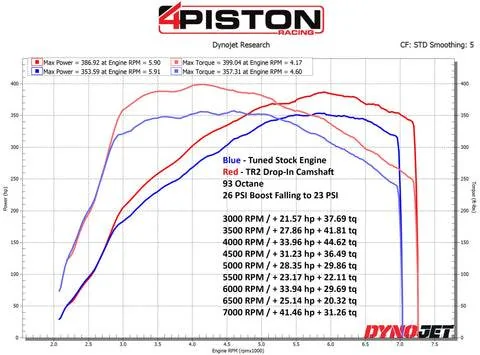
When modding for maximum performance, an upgraded turbo will eventually hit a bottleneck in power until you upgrade the camshafts. I think 4pistons was able to increase 40whp while broadening the power range.

Assuming the same boost levels, an upgraded cam can output more power than stock, provided the turbo compressor kicks out enough airflow to support power increase. At wide open throttle there should be no compromise in torque with gains thriving in the VTEC range.

To achieve same gains on turbo the boost psi level would need to be increased with the same fuel. If not, higher intake and fuel kit plus race fuel would have to be upgraded.

Cams would give you more power with the same fuel. Although retuning is necessary. Ideally I would want to avoid peak horsepower with large turbos with far too little torque. Peaky cars have all the top end power and none down low. The right sized cams would deliver frequently used mid-range power.

As DRob mentioned, 500hp could be achieved with the bolt on upgrades and fuel kit. I want to keep this car for a very long time so I’m exploring the building bottom up approach. Valve springs and strong rods would be important as well if we drop in large turbos and still maintain reliability.

That’s just my two cents; any input from people with experience taking either/both approaches is very much welcome.
 

optronix

Senior Member
Joined
Apr 15, 2023
Threads
27
Messages
1,698
Reaction score
2,442
Location
MD
Car(s)
2024 Integra Type S, 2023 Macan GTS
I think in any case this is not a car that makes sense to get to 500 whp. Go buy a Hellcat or something if you're after big power. You'll spend far less money and get more out of it. I feel like it's a complete waste to go for big horsepower figures in a car that was engineered for making turns but hey, it's your money.
 

ABPDE5

Senior Member
Joined
Jun 24, 2023
Threads
7
Messages
603
Reaction score
492
Location
ME
Car(s)
2024 Integra Type S
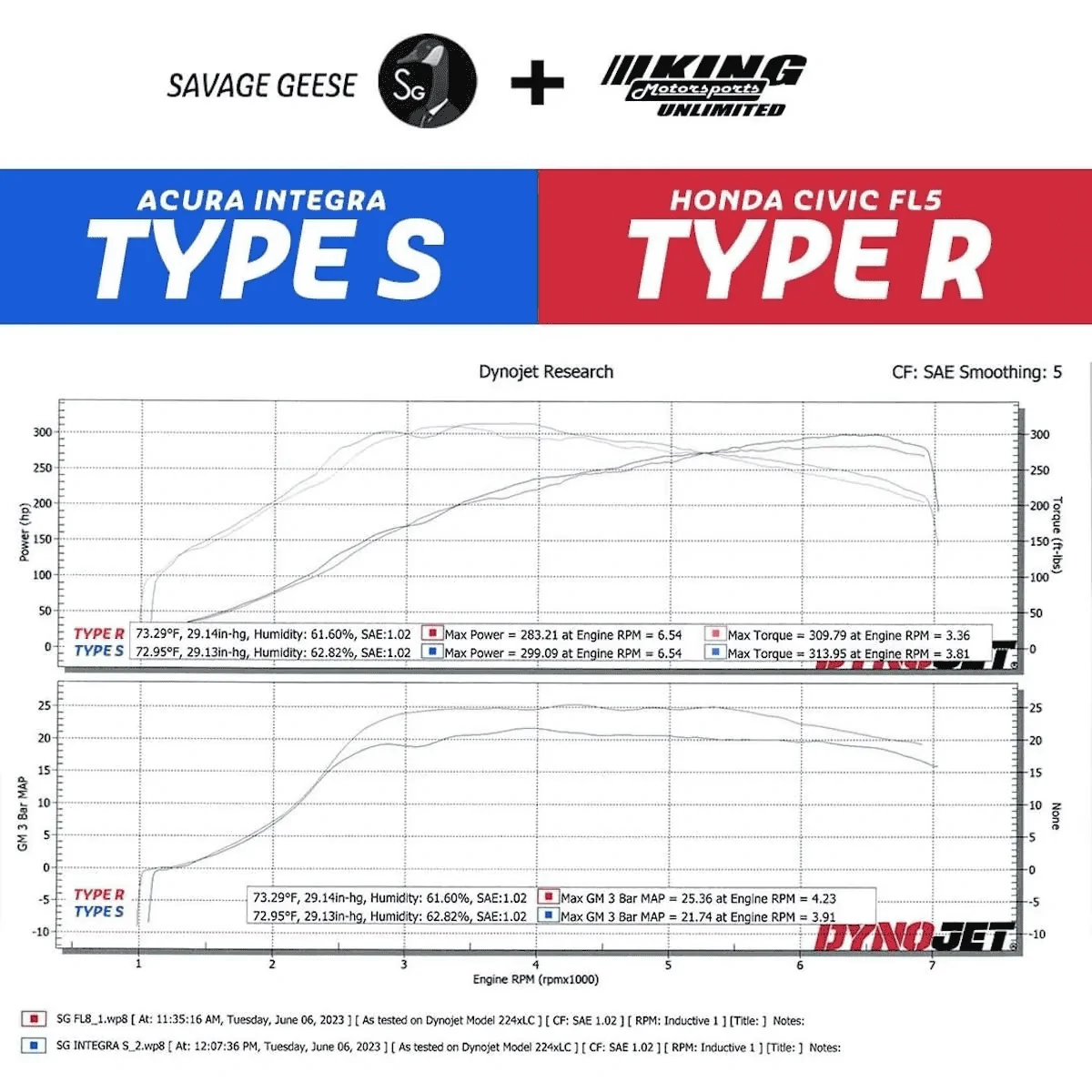
where is the 300 hp at the wheels dyno chart?
Pretty prevalent. The one that first jumps to mind is the Savage Geese video (dynoed the DE5 and FL5 back-to-back).
 

Sponsored

OP
OP

Azkyrie6

Senior Member
First Name
Henry
Joined
Jun 3, 2023
Threads
7
Messages
516
Reaction score
514
Location
Colorado
Car(s)
Acura TL, Acura MDX
I think in any case this is not a car that makes sense to get to 500 whp. Go buy a Hellcat or something if you're after big power. You'll spend far less money and get more out of it. I feel like it's a complete waste to go for big horsepower figures in a car that was engineered for making turns but hey, it's your money.
500hp can be done, just reaches a point of diminishing returns as we’ll get too much wheel spin on launching. That being said, there’s only so much revving the engine and dumping the clutch launches that any manual car can handle.

I’m still interested in bottom end upgrades and possibly some bolt ons to the 400-450hp range while retaining reliability, smooth power delivery through all 6 gears and no sacrifice in handling.

The old Integra Type R and S2K were excellent in bottom up approaches before the age of turbos.
 
OP
OP

Azkyrie6

Senior Member
First Name
Henry
Joined
Jun 3, 2023
Threads
7
Messages
516
Reaction score
514
Location
Colorado
Car(s)
Acura TL, Acura MDX
this is a good dyno chart. We see peak torque 2.5k-4K+ before tapering off while HP steady to 7k.

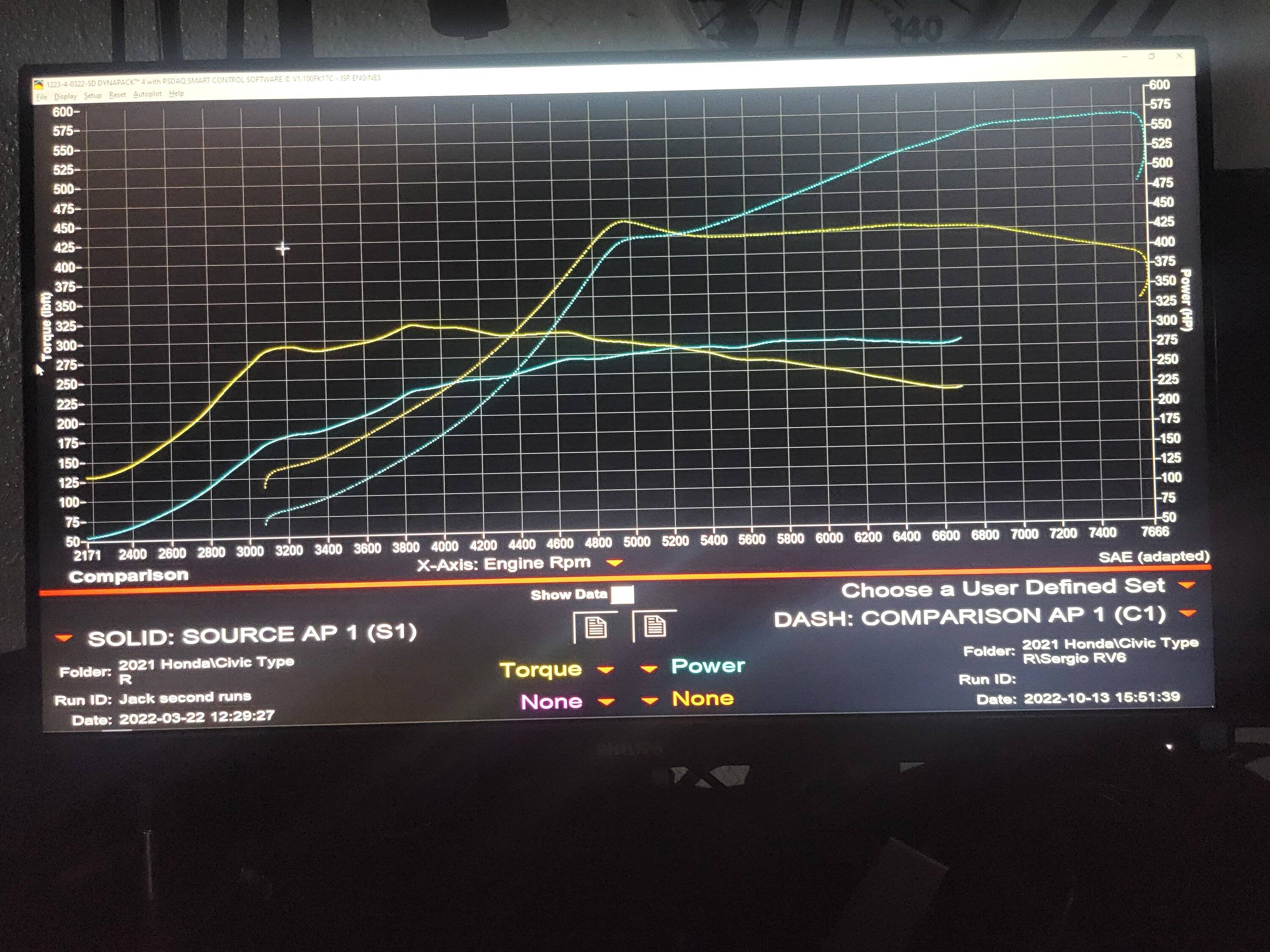
compare this to a stock civic type R FK6 and an rv660 turbo upgrade from @speedyserg :

Acura Integra Integra Type S K20C8 Engine? 3F1DBDBC-AC99-4FA7-868E-FFE1144D5C3A


In both cases stock torque comes on linearly with RPM.

The larger turbos spool slower than the stock MHI turbos. So you’ll only see the huge gains from 4500rpm and beyond while HP pulls hard through redline. This is ideal for FWD cars that want to go fast on straight lines. Having a rapid onset of torque low to midrange can potentially give us too much wheel spin at wide open throttle. Larger turbos makes up the HP on the top end for what it lacks down low.

For folks that want maximum power your turbos will kick in at 5k rpm, you’ll lose the lightning quick response on the low end in exchange for a huge rush on top end revving. This brings the experience back to the Integra type R /GSR days where Vtec kicks in with high rpm capability. However, this means your driving habit has to change to drive in the 4K-5k to redline more to keep the turbo spooling.

with this setup, tracking and spirited driving on twisty roads means that you’ll be downshifting more to get the revs up and taking advantage of the large turbo.

the other option is to bring in the torque sooner with large turbos, but your clutch and engine rods will not hold as well beyond the 450lbft torque. Those will need to be upgraded along with stickier tires. This introduces the reliability issue whether having too much power low-mid range or consistently revving the engine high. Of course Honda engines like revving but none of these upgrades are mutually exclusive, everything needs upgrade consideration for making power safely and keeping car reliable.

in the end, it all depends on what you want out of the ITS, your personal driving habits and how much you’re willing to spend to maintain reliability.
 
OP
OP

Azkyrie6

Senior Member
First Name
Henry
Joined
Jun 3, 2023
Threads
7
Messages
516
Reaction score
514
Location
Colorado
Car(s)
Acura TL, Acura MDX
Let's just say I'm curious as to how much cams would impact the overall performance of what this car is all about.
Going by 4pistons TR2 cams and their tuning, you’d be getting +44.62 torque in the 3k-4k RPM range. Then you’re gaining an average of 30HP across the powerband.


Acura Integra Integra Type S K20C8 Engine? 41551AE9-B9CE-437C-88D8-AF36B178F560

In practice, you’ll be instantly gaining a more powerful response on the low-midrange. This is where the experience is enhanced for twisty roads, autocross, tracking or daily driving.

Powerband is broadened so you won’t feel like there’s a sharp falloff after 5k rpm.
This extra burst coupled with some basic map tuning could really shine when you’re powering through corners. you’re not losing anything down low and still keeps door open for large turbo later for those that are into that.
Sponsored


Top