
Sponsored


TPMS for second set of wheels

WFORich

Member
First Name
Rich
Joined
Feb 20, 2025
Threads
1
Messages
10
Reaction score
9
Location
Cincinnati
Car(s)
24 Tacoma Sport, 2018 Mazda 6, 2 Acura RSX
Looking for advice on TPMS tire pressure sensors for my second set of wheels.
I believe if I buy OEM sensors 42753-T6N-E03 I will need a high end scanner to "register" them every time I switch wheels... correct?

So - I do have access to an Autel TPMS programmer so I figure if I buy 4 Autel compatible programmable sensors, I can clone my OEM sensors .
Is this my best option? Thanks!
Sponsored
 

ender_ong

Senior Member
First Name
Andrew
Joined
Jun 23, 2023
Threads
1
Messages
117
Reaction score
199
Location
Walnut Creek, CA
Car(s)
18 Ridgeline RTLE white/black, 24 DE5 white/black, 08 AP2 CR black
No need to “register” TPMS sensors, the car automatically pairs with the closest compatible sensors when wheels are installed. I switch between OEM wheels and FL5 forged accessory wheels and the pairing always works
 

optronix

Senior Member
Joined
Apr 15, 2023
Threads
27
Messages
1,699
Reaction score
2,442
Location
MD
Car(s)
2024 Integra Type S, 2023 Macan GTS
^this, automatically pairs up. I just bought the OEM sensors and had them installed on my Apex's, I've swapped them on/off twice now with the OEM wheels I use for winter and the sensors always just pair up without any action on my part.
 

Mr. LargeCoffee

Senior Member
Joined
Jun 7, 2024
Threads
5
Messages
86
Reaction score
46
Location
Liverpool NY
Car(s)
24 Integra ASpec w/Tech, 10 Mazda Miata MX5
I have sensors from tirerack. Yup, just put them on the car and drive, within a mile the pressures show up on the screen.
 

Victorofhavoc

Senior Member
First Name
Gordan
Joined
Jul 9, 2024
Threads
11
Messages
1,285
Reaction score
866
Location
Kansas City
Car(s)
Integra type s
Like others said, they don't need to be oem, just the same frequency (433hz I believe). No coding, just toss them in and go.

Stupid thing though... The car cannot be reprogrammed easily to adjust for an appropriate tire pressure on a different size tire. Stepping over to 18s and a taller sidewall for a winter tire means appropriate pressure goes way down (29/27 in my case) and the car just screams at you constantly about it. If you're going up in load rating on the sidewall, it's not worth it to even futz with the sensor other than seeing the pressure in the dash.

For the folks going to 18s for track tires, I would 100% skip the sensors for weight/balance and cost.
 

Sponsored

OP
OP
WFORich

WFORich

Member
First Name
Rich
Joined
Feb 20, 2025
Threads
1
Messages
10
Reaction score
9
Location
Cincinnati
Car(s)
24 Tacoma Sport, 2018 Mazda 6, 2 Acura RSX
Thanks for the info!
 

Truemyth

Member
Joined
Apr 21, 2025
Threads
1
Messages
35
Reaction score
12
Location
Lower Mainland
Car(s)
Nissan Versa
Like others said, they don't need to be oem, just the same frequency (433hz I believe). No coding, just toss them in and go.

Stupid thing though... The car cannot be reprogrammed easily to adjust for an appropriate tire pressure on a different size tire. Stepping over to 18s and a taller sidewall for a winter tire means appropriate pressure goes way down (29/27 in my case) and the car just screams at you constantly about it. If you're going up in load rating on the sidewall, it's not worth it to even futz with the sensor other than seeing the pressure in the dash.

For the folks going to 18s for track tires, I would 100% skip the sensors for weight/balance and cost.
Hi. If you would excuse my lack of knowledge and please explain why a smaller wheel diameter while keep the same (ish) overall wheel diameter/circumfrance would need or require a lower tire pressure?

And how does load rating also affect tire pressure?

I just don't know to much and trying to educate myself. I thought tire pressure is to maintain the contact patch. Side wall/load rating had to do with tire flex and feel. I mean I'm sure it's all interconnected in a way so hoping to get a better understanding.

Thanks in advance.
 

Victorofhavoc

Senior Member
First Name
Gordan
Joined
Jul 9, 2024
Threads
11
Messages
1,285
Reaction score
866
Location
Kansas City
Car(s)
Integra type s
Hi. If you would excuse my lack of knowledge and please explain why a smaller wheel diameter while keep the same (ish) overall wheel diameter/circumfrance would need or require a lower tire pressure?

And how does load rating also affect tire pressure?

I just don't know to much and trying to educate myself. I thought tire pressure is to maintain the contact patch. Side wall/load rating had to do with tire flex and feel. I mean I'm sure it's all interconnected in a way so hoping to get a better understanding.

Thanks in advance.
Great question!

Here's a link to a calculator that can help make things a bit easier, and they have some great explanations on there as well, https://tiresize.com/pressure-calculator/


Basically, there's a relationship between sidewall height and load bearing. Generally, the smaller the sidewall the less weight it can bear before the rim makes contact with the ground, thus requiring greater pressure. There's also standard load and extra large load. Most low profile tires (<45 sidewall) are extra load (xl). Ever notice that semis and their trailers never have lopro tires despite the lower rolling resistance they would offer? Load support is why.

Sidewall height is also a function of tire width, so a 255/40 is the same sidewall as a 225/45 and that's also why they typically have the same load rating. There's some variance between tire types and makes, but let's just ignore that for now... When changing rim size, you go up or down in sidewall to match height, so a 265/30/19 is the same circumference and overall height as a 265/35/18, but the 18 has a much taller sidewall and necessitates a lower pressure to maintain the same load!

In my winter tire case, I wanted a specific performance winter i really like, and I wanted a slightly taller sidewall so I got a 255/40/18. That's roughly an entire inch MORE sidewall than the factory tire. It has a correspondingly higher load rating.

Also important, load rating has a correlation to feel and comfort, but the sidewall and tire type has more impact on that than the load rating itself. Hence an all season in factory size is squishy and comfy, while a 200tw has you feeling an ant when you run over it 😅.


Where load rating matters:

Manufactures determine how much pressure needs to be distributed across the contact patch for both front and rear based on many factors, including vehicle weight, load bearing capacity, alignment, weight transition, drive type, spring rate, rollbar rate (also a spring), suspension type, and other tire/chassis variables.

If you change the expected load, the pressure would need to change to correspond, or else the tire might be over or under Inflated causing excess wear in the middle or outsides respectively.

Your tire type and it's inherent sidewall stiffness can also impact performance in YOUR specific use case. For example, let's say you're driving over sand for some reason, you'd want to drop that pressure to distribute the load so you don't sink. Similarly true for snow, but factors of ice and tire can create variance. In my track use example, I run the ps4s at 44psi front and 40 psi rear hot on factory size, but on a 265/35/18 I run about 3-4 psi lower. Coincidentally, the door pressure for the ps4s is a good starting point and the tire works itself to that 44/40 when hot. The same is true for the adjusted lower pressure on the 18s.

Many other factors, use cases, and reasons you'd want to change pressure, especially when changing tire size or pressure. That can get complex quickly. I'm happy to get into it, but that's a much deeper and mathy conversation than I believe you're wanting right now 🙂.
 

Truemyth

Member
Joined
Apr 21, 2025
Threads
1
Messages
35
Reaction score
12
Location
Lower Mainland
Car(s)
Nissan Versa
Thank you for that "just the right amount" of detailed explanation. Much appreciated. 👍 I have a set of 18x9.5 rims coming for my winter set up (probably 265/35 tires) and i'll definitely keep this in mind when pressuring those up.
 

Victorofhavoc

Senior Member
First Name
Gordan
Joined
Jul 9, 2024
Threads
11
Messages
1,285
Reaction score
866
Location
Kansas City
Car(s)
Integra type s
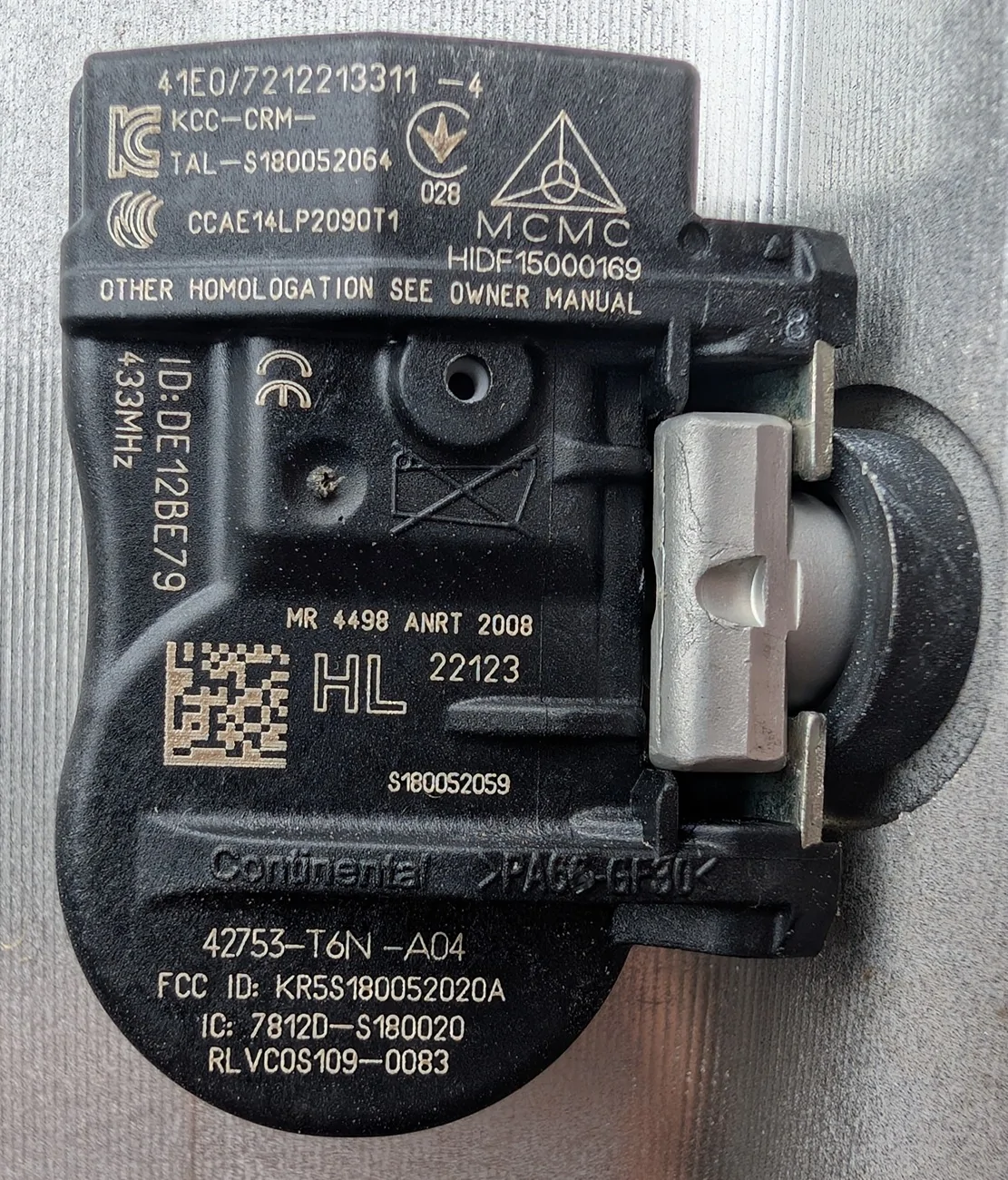
FYI here is a pic of the OEM TPMS Sensor and it is indeed 433mhz

TPMS OEM  25 ITS.jpg
Yeah they're continental.

I got them cheaper from the dealer than from continental directly. Oddly they came in a sealed Honda baggy which had a sealed continental baggy in it, because we clearly just like making trash... 8 plastic baggies for 4 sensors 😑
Sponsored


Top