Spart
Senior Member
- Thread starter
- #1
About six months ago, I did the clutch delay valve (CDV) delete and the clutch master cylinder damper (CMC damper) delete at the same time on my Integra Type S. If you have a non DE5 such as an A-Spec, I'm not sure if your car has the same CMC damper, but it definitely has the CDV and the steps to delete it will be the same. I did a full video on the how-to and analysis, which will be at the very bottom of the thread. So if you're looking for good instructions on the process, I will direct you there since it's best explained on video.
In order to get some objective data on the results, I used 1000(ish) frames per second high-speed video to capture the speed at which the clutch fork moves when the clutch pedal is sidestepped, both before and after.
The TL;DR here is that doing this mod eliminates about 1/10th of a second of lag/delay in the clutch per shift. It's really a hell of a difference.
Analysis - "the only difference between screwing around and science is writing it down"
Here's the just the high speed video, 960fps played back at 30fps for an effective 32x super-slow-mo:
When you see the green “play” icon flash on the left, that’s when the clutch pedal is being released. To ensure consistency I kept the ambient temperature at approximately 75 degrees fahrenheit, and performed these tests on a completely cold engine. I used Honda brake fluid to bleed the system, and I pressed the clutch pedal firmly to the floor with a large wooden dowel that I literally kicked sideways off the pedal in order to get consistent, sudden releases with no variation. I analyzed this video frame by frame at the pixel level in order to obtain data on the speed curve of the clutch fork movement.
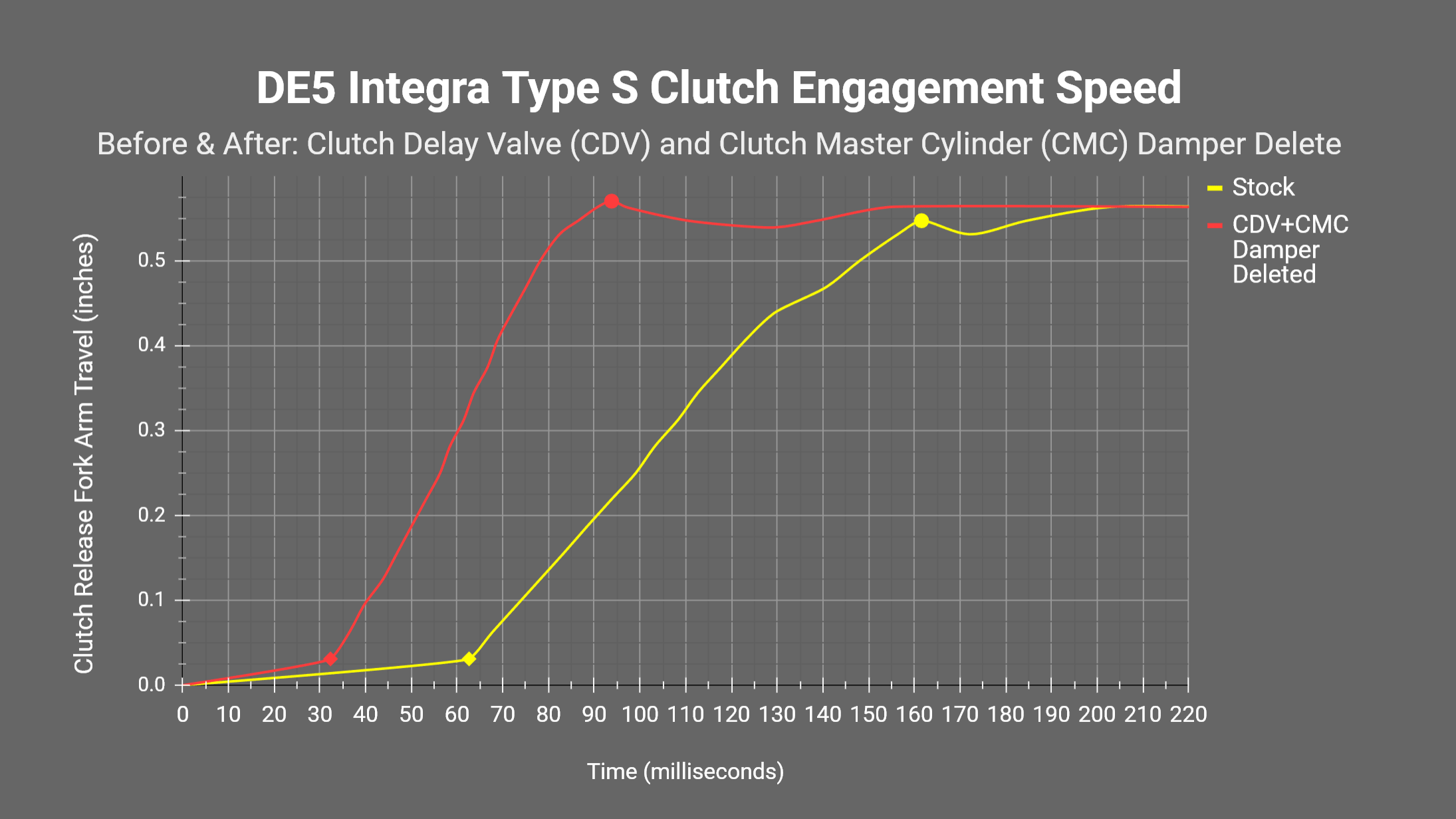
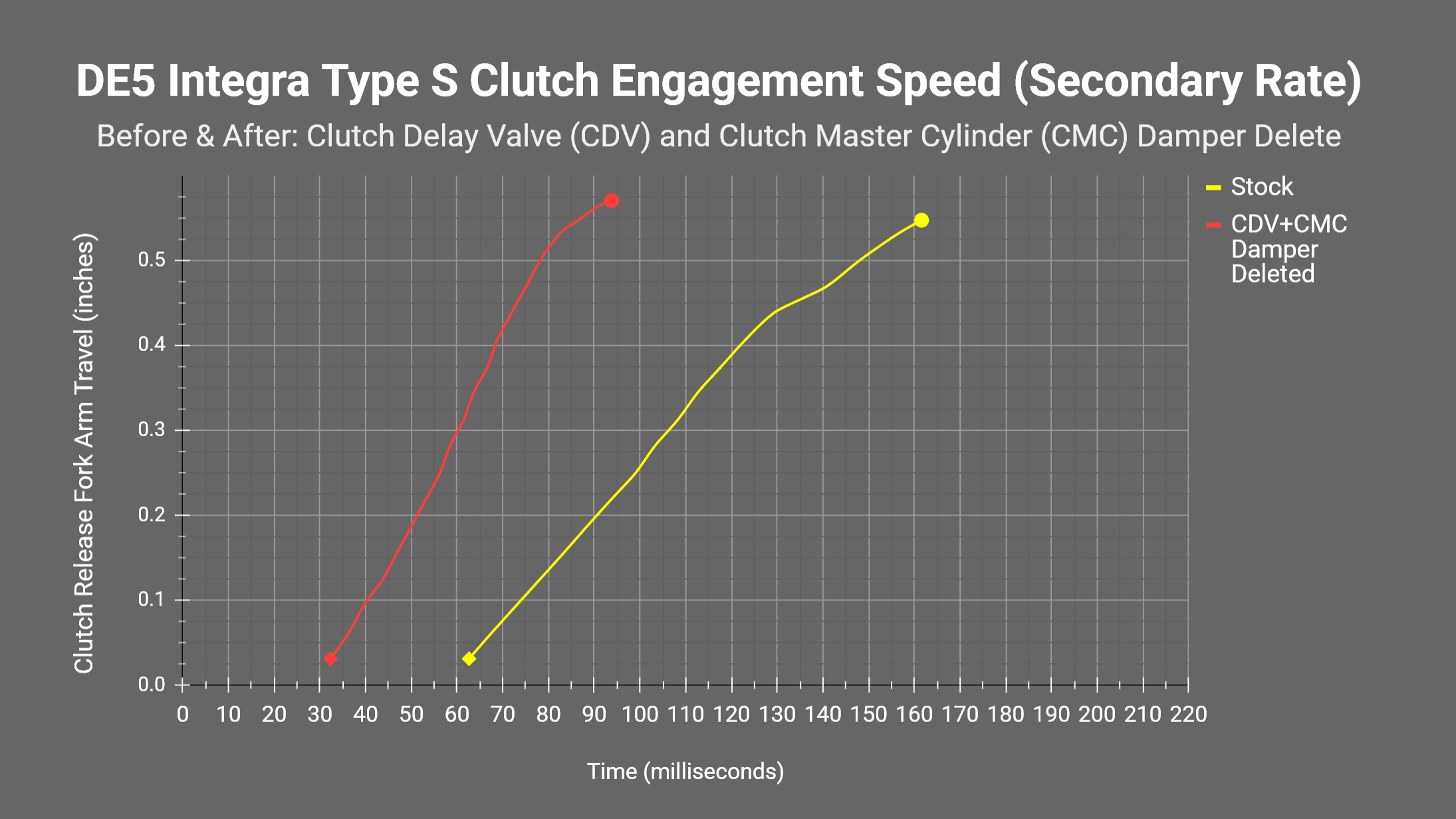
It's easy to see the difference visually, but I also wanted to quantify it exactly and break it down. So I analyzed the high-speed video frame by frame at the pixel level in order to get data on the rate of clutch fork movement. The metal ruler is there so I could establish the exact travel of the clutch fork relative to the elapsed time. You do see the ruler shift, but I only used it to establish a baseline pixel measurement. The data resulting from that analysis is shown here:

On the X or horizontal axis we have time in milliseconds. On the Y or vertical axis, we have clutch fork travel in inches. In yellow is the data for the stock setup, and red shows the deleted data. This slope of the lines conveys a rate of travel - the steeper the line, the faster the rate.
Just like the video, the difference is quite drastic. The deleted setup is actually 58% engaged by the time the stock setup begins to move at full speed.
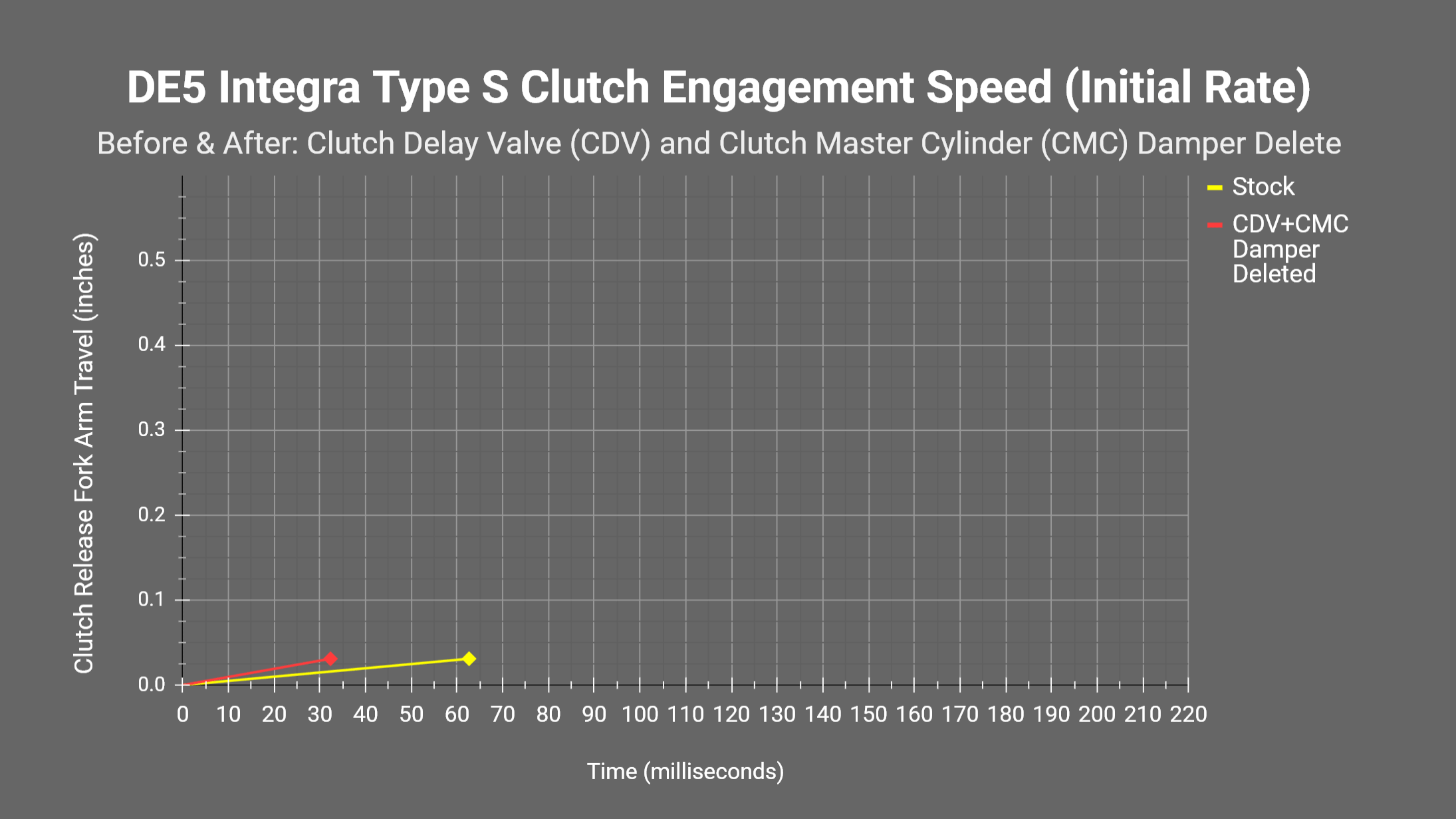
There are three obvious components to the rate of travel and I want to address the first two separately, because I think further testing would isolate each component to one of the two deleted parts. On the left side of the chart you see a diamond for both lines, and this diamond separates the first, slower rate of travel with the second, faster rate of travel. Let's focus on that first component of travel with this view:
Because the rate of travel is so slow in the first part, I don’t believe the CDV is actually what’s exerting influence here. Instead I think what is happening is that you’re seeing pressure equalize throughout the clutch hydraulic system once one end of it, the master cylinder, has lost pressure. My hypothesis is that during this event, the CMC damper is inducing delay. By the nature of how it works, the volume of fluid inside of the damper will evacuate towards the port with the lowest pressure, in this case in the direction of the master cylinder. Only once the pressure in the damper has equalized will fluid begin to flow through the damper from the slave cylinder. This would explain why the stock setup is slower to start moving at full speed, even though the clutch delay valve should only affect higher speed operation, not lower speed operation.
Numbers-wise, the fully deleted setup is nearly twice as responsive, taking only 32 milliseconds to begin full-speed travel versus 63 milliseconds stock. I want to assert here that I believe it would make sense that this 31 millisecond difference happens both when you press the pedal and when you release it, since the CMC damper works in both directions. So for each shift, I believe this delay happens twice for a total of 62 milliseconds of delay.
So now let's focus on the second component of the rate of travel, which is between the diamond and the circle marks on each line:
This seems to be the regime where we have stable hydraulic flow and the CMC damper is not in play. I believe the difference maker here is the clutch delay valve. Because the CDV acts as a flow restrictor, there is a limit on how fast the fluid can flow, and what you’re seeing is the maximum speed. Ignoring the first component of the rate of travel, the clutch fork finishes its travel in 99 milliseconds stock, and 62 milliseconds deleted. So by deleting the CDV, we have increased the rate of travel in this regime by about 37%.
Of course there is a third component to the rate of travel, and in that first chart above, you’ll notice the lines dip back down towards the X axis after the circle mark on the lines. That’s because there’s a bit of rebound. The rebound is actually stronger on the deleted setup, which makes sense because it’s engaging the clutch faster. I don’t believe this rebound is actually disengaging the clutch - I think it’s just the whole chain of components settling into place. The stock setup actually starts to rebound after about two hundredths of an inch less travel than the deleted one, and you can see this on the chart where the circle for the deleted setup is higher on the Y axis than the stock setup. They both eventually come to rest at the exact same 0.563 inches of travel.
Conclusion
So what does the sum of this all mean? Well in theory, the time penalty from the CDV only happens once per shift, only on the clutch pedal release. And in theory, the time penalty from the CMC damper happens twice per shift, both on the press and release of the clutch pedal. So if we put these numbers together - 62 total milliseconds of delay from the CMC damper, and 37 milliseconds of delay from the CDV, we get a total of 99 milliseconds of delay per shift. This is substantial - an extra tenth of a second of delay can result in quite a bit of clutch slip and be disorienting for the driver. One modern technology we can compare this to would be virtual reality headsets. With those, latency between input and visual movement over 20 milliseconds can cause motion sickness, and Honda’s gadgets here add five times that amount of latency. I think what’s worse is that this delay varies with speed of operation, making it harder to predict. So you can try to drive around them, but you’ll get different results using different speeds. That is definitionally unintuitive behavior from the car. It should also be noted that the effect is not binary, this isn’t something that only affects you when you operate the clutch at maximum speed. If you’re moving slower than maximum speed, the effect you will feel manifests as variable pedal pressure.
Subjective experience
Everyone will feel a little different about this mod because driving styles vary, and some folks just don't ever learn how to drive both aggressively and accurately.
I'm familiar with putting manual cars around a track and I've always done my own heel-toe downshifts. I keep the auto-rev match systems in my cars that have had them (only two our of like twelve so far) turned off, because for me that's part of the experience and engagement.
The effect of the CDV and CMC damper didn't really trip me up so much with your mundane, everyday driving. Where it got me was doing heel-toe and trying to be fast and accurate with the clutch. If you really rip a fast heel-toe downshift, your goal is to keep the engine connected to the wheels and provide engine braking. This keeps the balance of the car consistent. My heel-toe downshifts tend to always be pretty aggressive, because I'm really just keeping my mind and muscle memory sharp so I can use it when I really need it, when going fast.
That being said, I am much more effective at doing near-perfect downshifts now than I was before. There's also a very welcome improvement to consistent, aggressive upshifts. Overall there's just more immediacy to the clutch and it feels like it grabs harder or more abruptly.
How-to instructions
As I mentioned, the how-to is best communicated in the form of video. I detailed everything here, from how the CDV works, how to delete the CDV from a stock slave cylinder, how to delete the CMC damper and swap the slave cylinder out, and even how to thoroughly bleed the system. And at the end, I added the objective analysis you see above (so you can skip that part if you've read this whole post already!) That last step of doing a thorough bleed is something a lot of folks get wrong and they don't even know it. Doing something like this gets a lot of air into your master cylinder, and it can be hard to get it all out.
Here is the complete video:
It's a long video, and there are chapters/timestamps in the description to help you navigate it.
In order to get some objective data on the results, I used 1000(ish) frames per second high-speed video to capture the speed at which the clutch fork moves when the clutch pedal is sidestepped, both before and after.
The TL;DR here is that doing this mod eliminates about 1/10th of a second of lag/delay in the clutch per shift. It's really a hell of a difference.
Analysis - "the only difference between screwing around and science is writing it down"
Here's the just the high speed video, 960fps played back at 30fps for an effective 32x super-slow-mo:
When you see the green “play” icon flash on the left, that’s when the clutch pedal is being released. To ensure consistency I kept the ambient temperature at approximately 75 degrees fahrenheit, and performed these tests on a completely cold engine. I used Honda brake fluid to bleed the system, and I pressed the clutch pedal firmly to the floor with a large wooden dowel that I literally kicked sideways off the pedal in order to get consistent, sudden releases with no variation. I analyzed this video frame by frame at the pixel level in order to obtain data on the speed curve of the clutch fork movement.
It's easy to see the difference visually, but I also wanted to quantify it exactly and break it down. So I analyzed the high-speed video frame by frame at the pixel level in order to get data on the rate of clutch fork movement. The metal ruler is there so I could establish the exact travel of the clutch fork relative to the elapsed time. You do see the ruler shift, but I only used it to establish a baseline pixel measurement. The data resulting from that analysis is shown here:
On the X or horizontal axis we have time in milliseconds. On the Y or vertical axis, we have clutch fork travel in inches. In yellow is the data for the stock setup, and red shows the deleted data. This slope of the lines conveys a rate of travel - the steeper the line, the faster the rate.
Just like the video, the difference is quite drastic. The deleted setup is actually 58% engaged by the time the stock setup begins to move at full speed.
There are three obvious components to the rate of travel and I want to address the first two separately, because I think further testing would isolate each component to one of the two deleted parts. On the left side of the chart you see a diamond for both lines, and this diamond separates the first, slower rate of travel with the second, faster rate of travel. Let's focus on that first component of travel with this view:
Because the rate of travel is so slow in the first part, I don’t believe the CDV is actually what’s exerting influence here. Instead I think what is happening is that you’re seeing pressure equalize throughout the clutch hydraulic system once one end of it, the master cylinder, has lost pressure. My hypothesis is that during this event, the CMC damper is inducing delay. By the nature of how it works, the volume of fluid inside of the damper will evacuate towards the port with the lowest pressure, in this case in the direction of the master cylinder. Only once the pressure in the damper has equalized will fluid begin to flow through the damper from the slave cylinder. This would explain why the stock setup is slower to start moving at full speed, even though the clutch delay valve should only affect higher speed operation, not lower speed operation.
Numbers-wise, the fully deleted setup is nearly twice as responsive, taking only 32 milliseconds to begin full-speed travel versus 63 milliseconds stock. I want to assert here that I believe it would make sense that this 31 millisecond difference happens both when you press the pedal and when you release it, since the CMC damper works in both directions. So for each shift, I believe this delay happens twice for a total of 62 milliseconds of delay.
So now let's focus on the second component of the rate of travel, which is between the diamond and the circle marks on each line:
This seems to be the regime where we have stable hydraulic flow and the CMC damper is not in play. I believe the difference maker here is the clutch delay valve. Because the CDV acts as a flow restrictor, there is a limit on how fast the fluid can flow, and what you’re seeing is the maximum speed. Ignoring the first component of the rate of travel, the clutch fork finishes its travel in 99 milliseconds stock, and 62 milliseconds deleted. So by deleting the CDV, we have increased the rate of travel in this regime by about 37%.
Of course there is a third component to the rate of travel, and in that first chart above, you’ll notice the lines dip back down towards the X axis after the circle mark on the lines. That’s because there’s a bit of rebound. The rebound is actually stronger on the deleted setup, which makes sense because it’s engaging the clutch faster. I don’t believe this rebound is actually disengaging the clutch - I think it’s just the whole chain of components settling into place. The stock setup actually starts to rebound after about two hundredths of an inch less travel than the deleted one, and you can see this on the chart where the circle for the deleted setup is higher on the Y axis than the stock setup. They both eventually come to rest at the exact same 0.563 inches of travel.
Conclusion
So what does the sum of this all mean? Well in theory, the time penalty from the CDV only happens once per shift, only on the clutch pedal release. And in theory, the time penalty from the CMC damper happens twice per shift, both on the press and release of the clutch pedal. So if we put these numbers together - 62 total milliseconds of delay from the CMC damper, and 37 milliseconds of delay from the CDV, we get a total of 99 milliseconds of delay per shift. This is substantial - an extra tenth of a second of delay can result in quite a bit of clutch slip and be disorienting for the driver. One modern technology we can compare this to would be virtual reality headsets. With those, latency between input and visual movement over 20 milliseconds can cause motion sickness, and Honda’s gadgets here add five times that amount of latency. I think what’s worse is that this delay varies with speed of operation, making it harder to predict. So you can try to drive around them, but you’ll get different results using different speeds. That is definitionally unintuitive behavior from the car. It should also be noted that the effect is not binary, this isn’t something that only affects you when you operate the clutch at maximum speed. If you’re moving slower than maximum speed, the effect you will feel manifests as variable pedal pressure.
Subjective experience
Everyone will feel a little different about this mod because driving styles vary, and some folks just don't ever learn how to drive both aggressively and accurately.
I'm familiar with putting manual cars around a track and I've always done my own heel-toe downshifts. I keep the auto-rev match systems in my cars that have had them (only two our of like twelve so far) turned off, because for me that's part of the experience and engagement.
The effect of the CDV and CMC damper didn't really trip me up so much with your mundane, everyday driving. Where it got me was doing heel-toe and trying to be fast and accurate with the clutch. If you really rip a fast heel-toe downshift, your goal is to keep the engine connected to the wheels and provide engine braking. This keeps the balance of the car consistent. My heel-toe downshifts tend to always be pretty aggressive, because I'm really just keeping my mind and muscle memory sharp so I can use it when I really need it, when going fast.
That being said, I am much more effective at doing near-perfect downshifts now than I was before. There's also a very welcome improvement to consistent, aggressive upshifts. Overall there's just more immediacy to the clutch and it feels like it grabs harder or more abruptly.
How-to instructions
As I mentioned, the how-to is best communicated in the form of video. I detailed everything here, from how the CDV works, how to delete the CDV from a stock slave cylinder, how to delete the CMC damper and swap the slave cylinder out, and even how to thoroughly bleed the system. And at the end, I added the objective analysis you see above (so you can skip that part if you've read this whole post already!) That last step of doing a thorough bleed is something a lot of folks get wrong and they don't even know it. Doing something like this gets a lot of air into your master cylinder, and it can be hard to get it all out.
Here is the complete video:
It's a long video, and there are chapters/timestamps in the description to help you navigate it.
Sponsored